Blind Touch: How well does it represent blindness?

![[Game cover image showing a little white man with black glasses and a cane walking down the street]](https://static.wixstatic.com/media/43878a_e082e34603ef4b5591511feabdfbc75d~mv2.png/v1/fill/w_616,h_353,al_c,q_85,enc_avif,quality_auto/43878a_e082e34603ef4b5591511feabdfbc75d~mv2.png)
Blind Touch is a game by Flygogo Games that describes itself as a blindness simulator. According to the Steam store , we'll explore a world of darkness with only the aid of our walking stick, recreating the environments we traverse through interaction and imagination, in an immersive sensory journey.
The developer stated that they had the support of blind people , but unfortunately, we were unable to contact them, and there is no trace of Flygogo on the international portal where blind players gather; it's a shame, as we would have liked to speak to them to better understand the creation process.
The context
Before analyzing the game, a few preambles: I've been blind since birth and have been a gamer for over 15 years.
This means that I'm an expert on accessibility and blindness, but I haven't personally experienced losing my sight. However, I know many people who have, and I'll draw on their experiences to try to give an objective opinion.
The second premise is that I haven't completed the game myself, because... Blind Touch isn't accessible to the blind . Which makes sense, considering it was created to offer a simulation of blindness to sighted people. To form my opinion, I watched gameplay videos, read some online threads, asked a sighted colleague for help, and played as little as I could, namely the first 5 minutes.

The plot and gameplay
In Blind Touch, we play a person who has just lost his sight and memory due to trauma. In reality, he still has some vision, so technically he's visually impaired, a very different condition from the blindness mentioned in the title.
The theme is obviously heavy, and is immediately underscored by the dramatic piano that soundtracks the start menu. To give us a further taste of the "emotions" we'll experience, the various options are written in braille, indecipherable until you focus on them with the mouse.
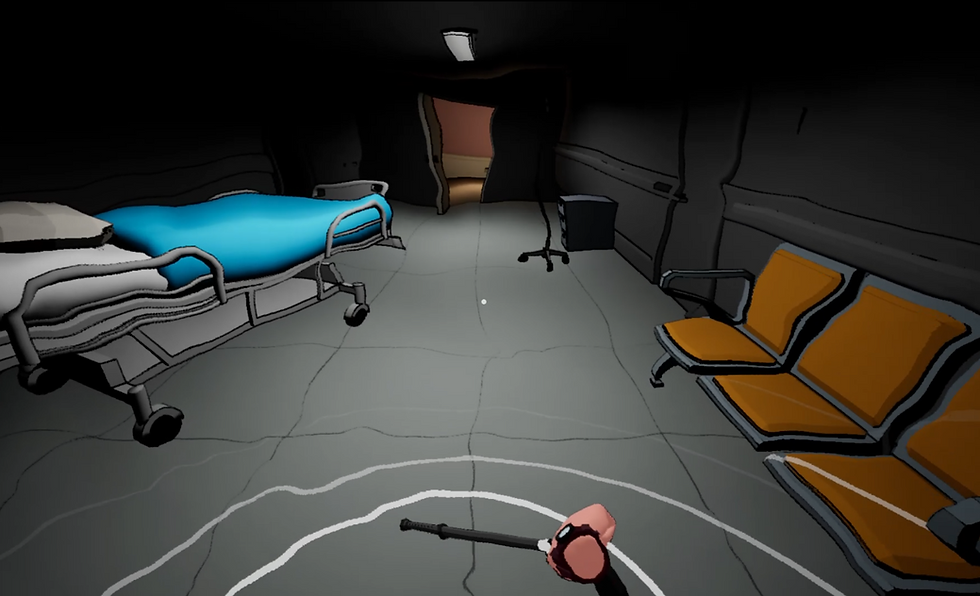
We click on new game and wake up in a hospital room. Here we receive a summary of our new condition and are invited to explore the room following certain sounds and making the most of our limited remaining vision. The experience is disorienting, given that we've lost our most important sense. Luckily, we soon find the iconic white cane, which for the rest of the game will help us move with greater awareness and recognize the objects around us.
Disorientation and frustration, however, remain with us until the end: each level challenges us to navigate increasingly complex environments, while completing tasks that would be trivial for a sighted person. We'll use our cane to identify everything, from a chair blocking our path to the alarm clock on the bedside table. All this is punctuated by dialogues that remind us of the burden of our condition and the satisfaction of finally finding the piece of furniture or the street we were looking for.
Simulation vs. reality
Blind Touch isn't the first video game to simulate blindness. Think, for example, of A Blind Legend or Lost In Blindness , whose screens don't show video because the protagonist is blind. In other fields too, people and associations have followed this path in a variety of ways; dinners in the dark to raise awareness and glasses that reduce the field of vision are famous. However, Blind Touch openly positions itself as a blindness simulator, which, in our opinion, opens the door to various problems.

As mentioned, we'll use the stick to identify practically anything, holding it raised in front of us almost like a sword. It goes without saying that, by doing so, we'll break various objects accidentally hit by our stick, a good indication that something is wrong. In reality, the stick is an aid that must slide along the ground to indicate holes, steps, and obstacles, so much so that the market offers tips for every terrain.
You might lift your cane slightly to measure the height of a step or to better understand the dimensions of a bicycle, but only a sighted person would recommend using it to recognize an object. Above all, it's not used to recognize objects placed on tables or furniture, precisely because they might fall. Much more simply, you use your hands. Have you ever seen those movies where a blind person asks you to touch a face to learn its shape? That's not entirely correct either, but it's already much closer to the behavior of a person who has become visually impaired.
The range of emotions the game forces us to experience is also unrealistic. It's true, losing your sight creates a lot of frustration. The brain literally has to change the way it processes information , and yes, actions that used to be easy now seem incredibly complicated. However, disorientation is a transitional phase. It happens that you knock over objects and get lost in familiar surroundings, but over time, blindness becomes a habit... It's like children learning to walk: at first they fall often, but then they move without problems.
The sound system isn't detailed enough to allow us to navigate using hearing alone. There's very little ambient noise, which is essential for blind players to orient themselves, and there's no real simulation of echolocation— that superpower that allows us to recognize the presence of walls or large obstacles based on the movement of the air in front of us, like bats. This "Eco Mode" essentially acts as a visual cue, showing us the point we need to reach to complete the objective , or the end of the level. Furthermore, interacting with doors or buttons requires positioning the mouse over them with extreme precision, which, paradoxically, requires excellent residual vision.

Finally, we wonder why someone so in need of support lives completely alone. In Blind Touch , let's remember, we have lost not only our sight, but also our memory, a factor that makes our condition even more delicate. This, in part, might explain the constant struggle to interact with our environment, even when it should be familiar, but it raises a whole other series of considerations, for example, why we are abandoned to ourselves as soon as we receive the white cane. It's undeniable that support structures are often inefficient. It's also undeniable that those who acquire a disability often find themselves abandoned by many friends, resulting in depression and social problems. However, in reality, sooner or later, new communities are found, so much so that one of the most common experiences among those losing their sight is the rediscovery of more authentic bonds, based on affinity rather than aesthetics.
The game's total solitude opens up an even more controversial level of interpretation when combined with the objectives to be achieved. To complete a level, we must become skilled at recognizing objects and moving independently , which, especially in the early hospital scenes, could convey the feeling of being guinea pigs rather than people, rewarded for managing to live a normal life. Here, ironically, may lie the most accurate point of the simulation. Often, people with disabilities are taught to be as non-disabled as possible, no matter how much effort it takes. This is because autonomy makes us free, but also because we shouldn't be a burden , and the more normal we are, the more accepted we are. We honestly don't know if the game intended to convey these nuances. Its mechanics certainly recall them, however, with all the cultural implications that this entails.
The TTS bracket
On the accessibility side of the game, however, the parenthesis relating to a function that, if well-made, could have made it accessible to the segment of people with visual impairments is merciless: the TTS (Text To Speech), a function that could have been really impactful , but which was left in a rather basic state .
The feature is disabled by default, available only in English, and requires navigating the menu to find it. Once enabled, it simply reproduces some items from the game menu , such as subcategories, but ignores several of the options within them. Or, in the case of difficulty settings, it doesn't provide detailed explanations of the differences.
Within the levels, however, it describes unlockable items as trophies, ignoring much more useful elements like walls, obstacles, directions to follow, or even the objectives of the missions to complete. The voice acting is also rather basic and not up to par with modern TTS systems, sounding robotic and lacking in expression. It should also be noted that the quality deteriorates further when the system language is set to Italian: the TTS uses an English pronunciation that makes words in our language almost incomprehensible to the ear.
The question of representation
The experience Blind Touch offers us is part of a long series of representations of disability as a problem. The game's protagonist is struggling, living in a hostile world and feeling his life is being shattered, just as in many films and video games. The connection between difficulty and blindness is one of the strongest; consider that when video games featuring blind protagonists are created, they're often horror films, reinforcing the association that darkness equals fear, a natural association for those who can see.
Portraying disability solely as a problem, however, risks causing harm in the real world. People with disabilities struggle fiercely against a society that still views them as unfortunate, infantilized, or too difficult to integrate, denying them rights and self-determination. This doesn't mean their difficulties shouldn't be discussed; on the contrary, anything that raises awareness is welcome. However, an accurate simulation of blindness should, in our opinion, convey all the nuances associated with it, including the possibility of having friendships and a fulfilling life, which, among other things, would also make gameplay more varied.

Conclusions and a personal comment
It was difficult for me to review this game. From the moment I launched it and discovered it wasn't accessible to the moment I noticed the loneliness issue, I experienced a rollercoaster of emotions, from frustration to a determination to play it anyway. I also laughed a lot. I imagined what a "normal person simulator" would be like, and maybe one day I'll program it, incorporating all the stereotypes that make people with sight think that going blind is the worst thing in the world.
That said, it's a great time for video games and disability. More accurate representations of disabled people, major studios moving to create inclusion standards, and there are wonderful signs that things are changing for the better, thanks in part to artificial intelligence that allows for easier modding , making more and more games accessible. My invitation, therefore, is to play Blind Touch anyway . And then, compare it with other experiences, to understand the full spectrum of what exists and what can truly be done with such an important and multifaceted topic.


Comments